
A gate driver is the interface between the control loop and the power stage. Whether to isolate it is a system architecture decision first, not just a component pick.
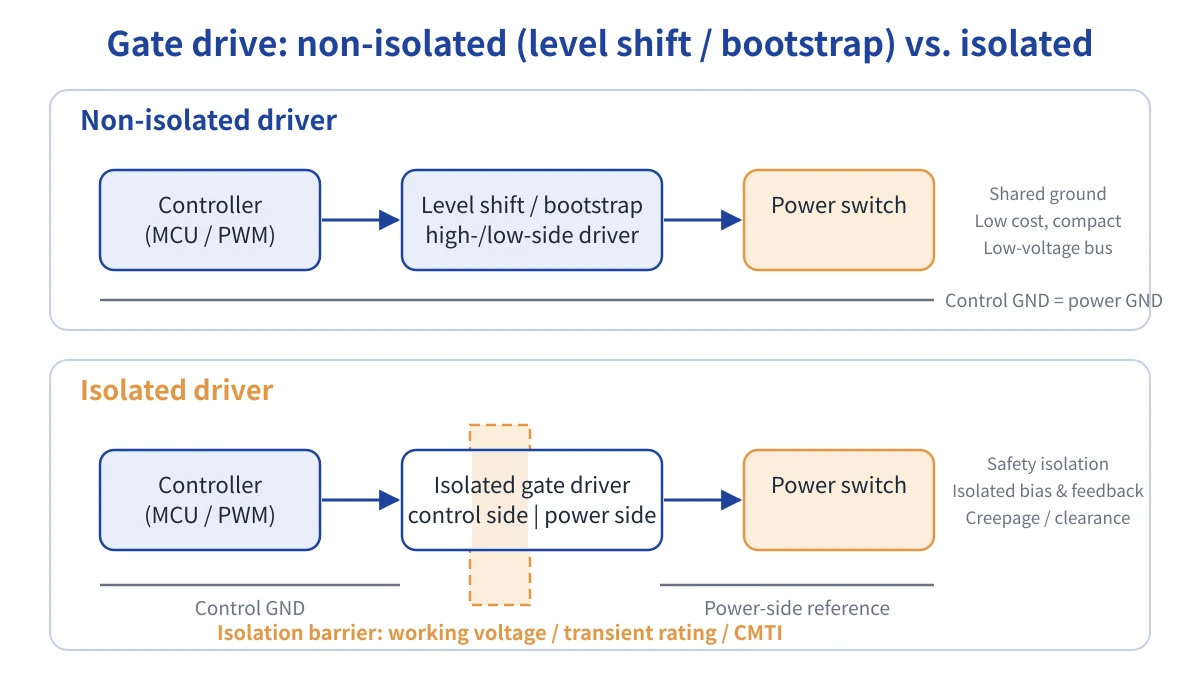
Non-isolated (level shift / bootstrap) versus isolated gate-drive architectures
What isolation actually solves
Non-isolated drivers share a ground reference with the control circuit, handling high-side switching through level shifting or a bootstrap supply. They cost less and use less board area, suiting low-voltage buses or simple reference configurations — low-side switches, bootstrap-based half-bridges.
Isolated drivers build a withstand-voltage barrier between the control side and the power side, providing safety isolation rather than level shifting. Once bus voltage requires safety separation or a functional-safety boundary, a bootstrap cannot substitute for a genuine isolated driver — selection must also weigh working voltage, transient rating, and the safety boundary implied by functional versus reinforced insulation.
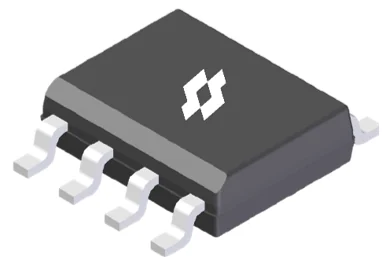
Single-channel isolated gate driver IC (SOP-8 package). Image: SineSemi
CMTI is the hidden bar
Wide-bandgap devices such as SiC switch faster, producing steeper common-mode transients on every switching edge across the isolation barrier. Common-mode transient immunity (CMTI) therefore matters as much as the withstand rating itself: a part that meets its voltage spec but falls short on CMTI margin can still misfire or lose signal integrity.
Protection features follow the architecture
Split outputs, active short-circuit (ASC) protection, and soft turn-off — protection against power-module overcurrent and short-circuit faults — mostly appear in isolated driver families, because these applications already need isolation to carry high-voltage feedback. Multi-channel isolated drivers go further, moving programmable dead-time and overlap protection on-die, shifting interlock logic from board level into the device itself.
System-level trade-offs and common pitfalls
Isolation is not a standalone component choice but one link in a system-wide isolation architecture, which also needs an isolated bias supply and isolated feedback. Common pitfalls: treating a bootstrap as safety isolation; checking only the withstand number while ignoring whether CMTI margin matches actual switching steepness; overlooking board-level creepage and clearance — the withstand rating is a controlled-test-condition figure, and the layout still has to satisfy the relevant safety standard on its own.
Parts can be filtered and compared within the gate driver categories by insulation rating, CMTI and package — or reach out to our engineers for an architecture-level assessment.