
Synchronous rectification (SR) replaces a Schottky diode with a MOSFET, and the lower conduction drop is not in question; what actually delivers that gain is the controller's judgment of when to turn on and off — a question tied tightly to topology. Pick the wrong part family and the efficiency math doesn't close.
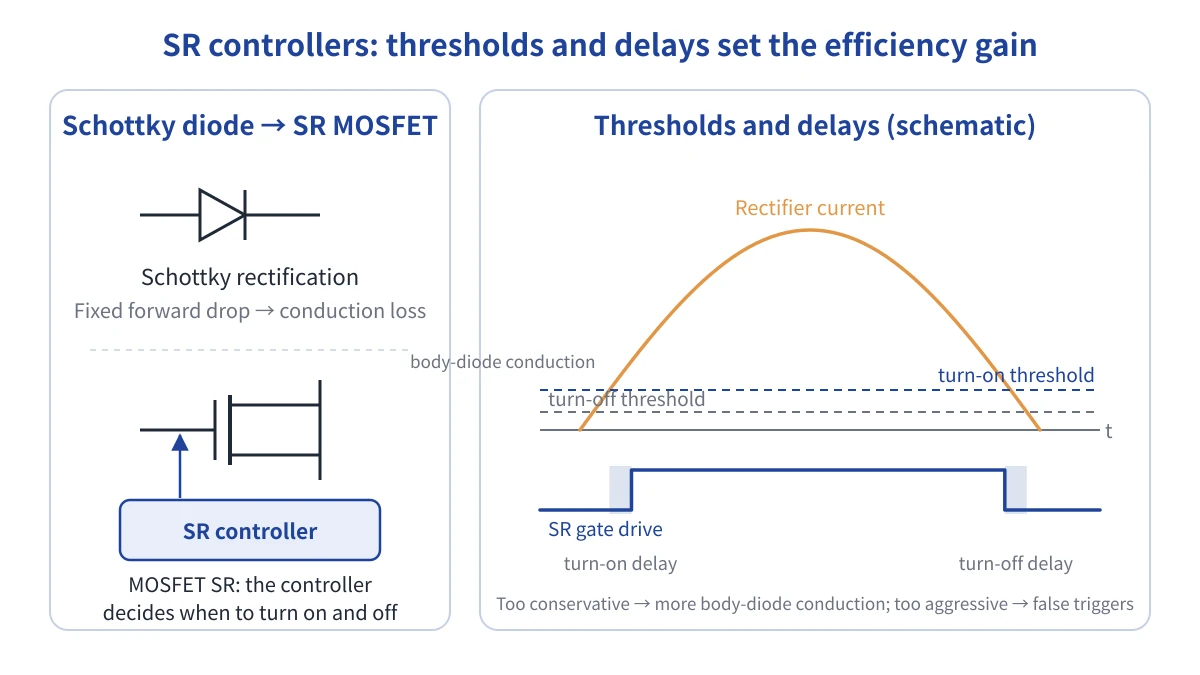
Synchronous rectification: the controller's thresholds and delays decide how much of the gain is realised (schematic)
Start with what the topology needs to sense
Flyback converters (especially in QR/DCM mode) rely on drain-voltage sensing to decide turn-on timing; LLC half-bridge resonant topologies, by contrast, have a more regular current zero-crossing but far less tolerance for turn-on/turn-off delay, and a slightly long delay cancels out the rectification gain. The first selection step isn't comparing datasheet columns; it's confirming the controller's supported operating modes actually cover the target topology.
Thresholds and delays are where the efficiency math lives
Set the turn-on threshold conservatively and the MOSFET turns on late, extending body-diode conduction and raising losses; set it aggressively and light-load or ringing-heavy conditions risk false triggering, adding switching loss and EMI exposure. The turn-off threshold works the same way: too early leaves a dead-time conduction gap, too late pushes toward the current zero-crossing where added noise risks reverse conduction. Whether this threshold-and-delay set tracks the topology's real current inflection point matters more than any single spec — exactly where a digital adaptive architecture earns its keep over fixed-threshold designs.
Light-load behavior and package format count too
Light-load or green-mode behavior sets performance at the low end of the load curve, and chargers need good efficiency across the full load range. Minimum turn-on/turn-off time limits how narrow the drive pulse can be compressed, which determines whether burst-mode operation stays stable without misfiring. Pairing a controller with a discrete MOSFET versus one with an integrated MOSFET (offered across several voltage-rating options) is another trade-off: the integrated approach simplifies layout, but on-resistance and voltage rating are locked to one part number, so selection needs enough margin; the discrete approach is more flexible but places heavier demands on layout and drive-loop design.
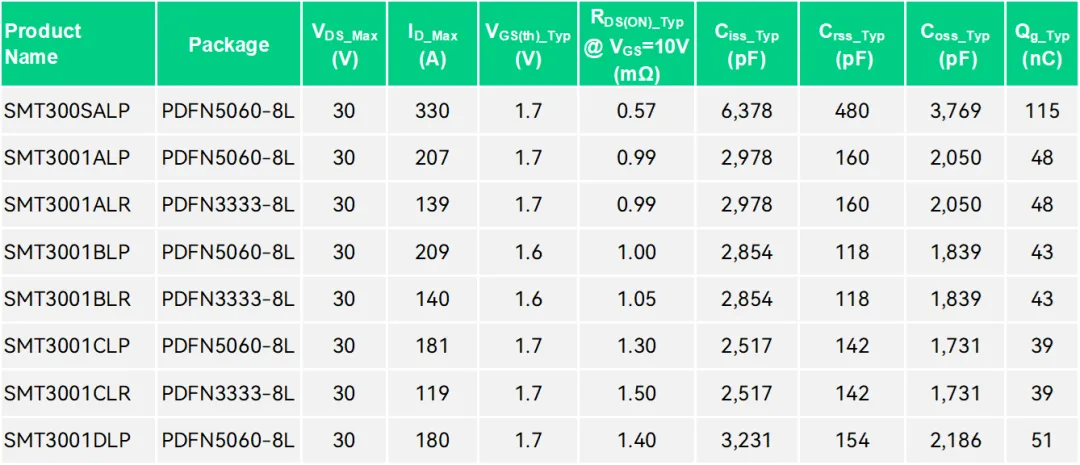
Example selection parameters for a discrete SR MOSFET (30V line-up table). Image: SineSemi
The point of a multi-mode digital adaptive architecture is covering multiple topologies and load ranges with one controller family, cutting the number of part numbers and the platform qualification work that comes with each — an efficiency account at the supply-chain level as much as the circuit level. For a specific design, candidates can be filtered and compared on-site by topology requirement and package, or reach out to our engineers for an assessment.