
The first fork in flyback controller selection isn't control mode — it's whether the power switch lives inside the controller die. A discrete-architecture controller handles only drive logic and protection decisions, leaving the power MOSFET as an external component; an integrated architecture puts the power switch on the same die, folding the gate-drive loop and thermal sensing inside one package. This choice precedes any datasheet comparison, and it shapes everything downstream — layout, thermal design, and how easily a part number carries across a product line.
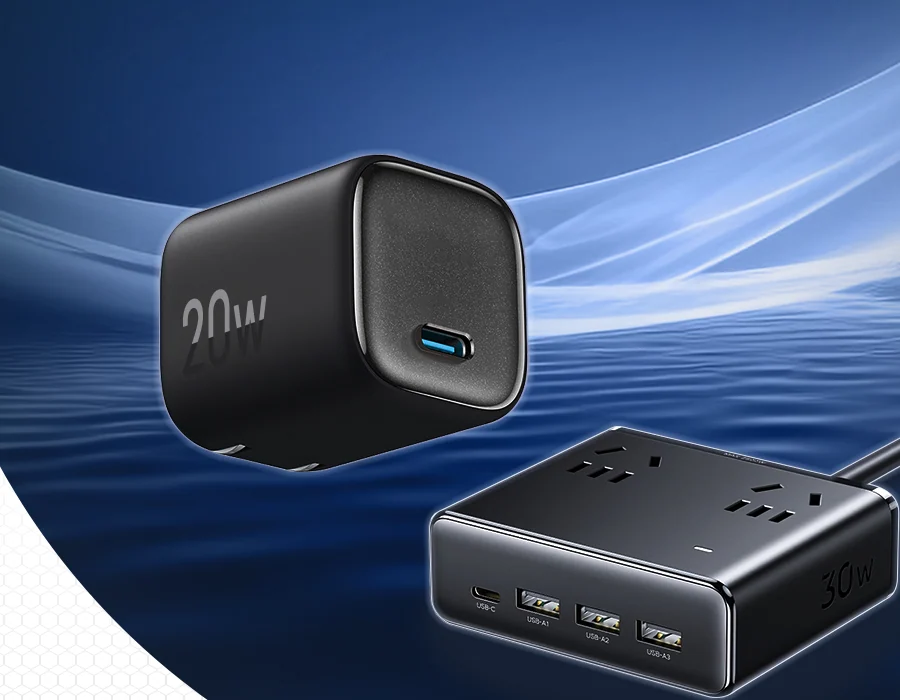
AC/DC adapter application key visual. Image: HYASIC
What integration buys you — and what it locks in
Bringing the power switch onto the die shrinks the gate-drive trace to almost nothing, cutting parasitic inductance and ringing and widening the margin for EMI compliance — compact adapters and low-power standby supplies often pay for that. The internal OTP sensing point sits closer to the switch itself, so thermal protection responds to actual junction temperature rather than a board-level estimate, a level of accuracy discrete designs struggle to match with an external thermistor. The cost is that on-resistance and voltage rating are fixed together in one part number: a shift in power level or reflected voltage usually means swapping the whole controller rather than a MOSFET, cutting into platform reuse. Loss also concentrates in a single package, narrowing the freedom available in thermal-path design.
What a discrete power switch buys — and what it costs in coordination
Pairing an external MOSFET means on-resistance, voltage rating, and package thermal resistance can all be selected independently, letting one controller carry across several power tiers and cover different product lines — useful for platform reuse and cost targets. But the gate-drive loop now depends on layout to suppress parasitics, and protections such as VCC OVP, output OVP, undervoltage lockout, and brown-out — which an integrated part can coordinate on-die — now rely on the signal path between controller and external device, demanding more layout and component-selection experience. Where the external OTP sensor sits directly determines whether thermal protection responds fast enough.
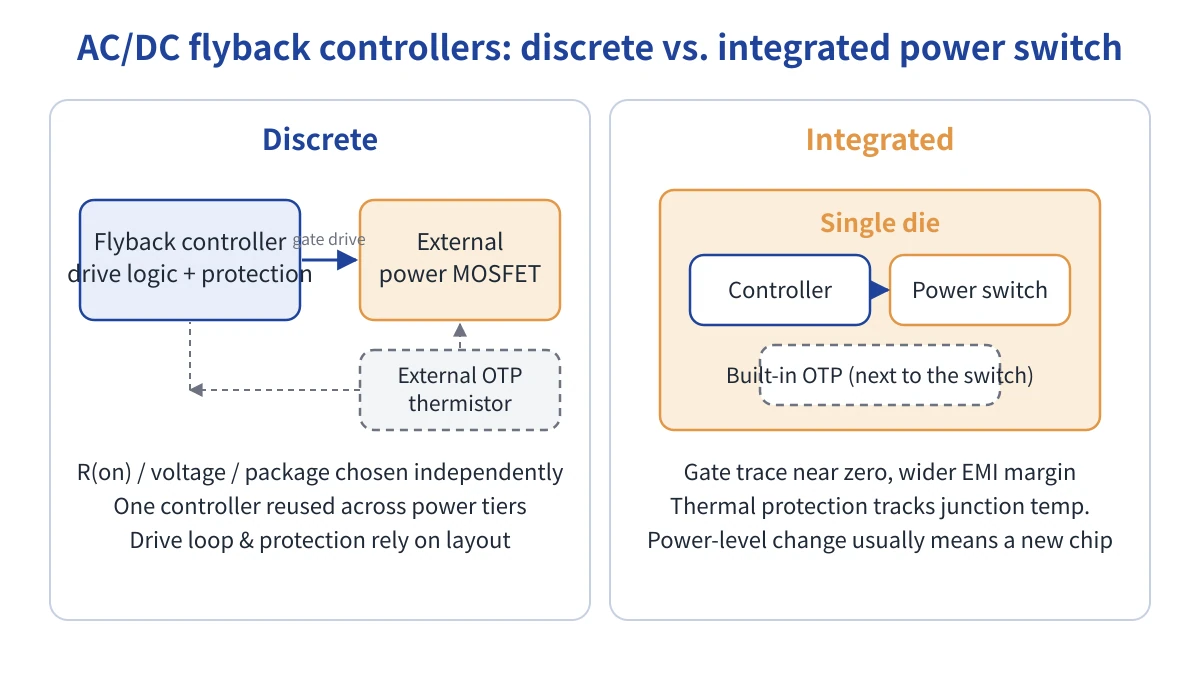
Discrete versus integrated power-switch flyback architectures
Grounding it in magnitudes: voltage class, frequency and standby
A few magnitudes help place a design quickly. For flyback supplies on universal AC input (85–264 Vac), the power switch is commonly rated 650 V or 700 V to leave margin for reflected voltage and leakage-inductance spikes; high-voltage rails or designs with a PFC front end push toward the 900 V class. On switching frequency, fixed-frequency designs commonly run 50–130 kHz, while quasi-resonant/valley-switching schemes vary frequency with load to hold down switching loss — higher frequency shrinks the transformer but raises sensitivity to switching loss and EMI. Standby is often where integrated solutions focus: paired with burst/skip modes, modern designs can pull no-load input power down to the tens-of-milliwatts range to meet eco-design rules. These ranges are for narrowing the candidate set, not a substitute for checking against a specific part number.
Selection order: settle power headroom first, then compare control details
Multi-mode adaptive control, maximum switching frequency, dynamic load response, and constant-current compensation all matter equally across both architectures — a higher switching frequency shrinks magnetics but raises sensitivity to switching loss, and mode coverage decides whether light-load and full-load performance can both be met. The real difference is sequencing: decide first how much power headroom and thermal-design freedom a given supply can trade away for an integrated solution, then compare efficiency and protection coverage within that architecture, saving a redesign later. AC/DC controllers like these are represented in the lines we distribute, and the package, control-mode and protection trade-offs for specific candidates are worth walking through with our engineers.