
The EU Common Charger Directive (Directive (EU) 2022/2380) has entered its mandatory phase. Published in the Official Journal of the EU on 7 December 2022, it supplements the implementation requirements for a common charging interface under Article 3.3(a) of the Radio Equipment Directive (RED, Directive 2014/53/EU). For teams building chargers, adapters and device-side power, it turns the interface and protocol from an open choice into a requirement.
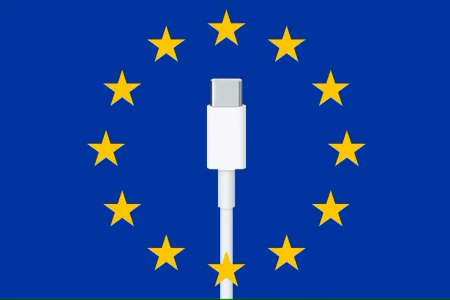
The EU Common Charger Directive and USB-C. Image: HYASIC
Key points of the directive
- A unified USB-C interface: devices in scope must be equipped with a USB Type-C charging port conforming to EN IEC 62680-1-3:2022, and must be chargeable with cables conforming to the same standard.
- Fast charging must support USB PD: devices that support fast charging (greater than 5 V, or 3 A, or 15 W) must support the USB PD protocol conforming to EN IEC 62680-1-2:2022.
- Unbundled chargers: consumers may buy a device without an included charger, and manufacturers must provide relevant information about the device's charging performance.
- Coverage of 13 categories of radio equipment, including smartphones, tablets, digital cameras, headphones, handheld game consoles, portable speakers, e-readers, keyboards, mice, portable navigation systems and laptops.
- Timeline: for the 12 categories other than laptops, the mandatory date is 28 December 2024; for laptops it is 28 April 2026.
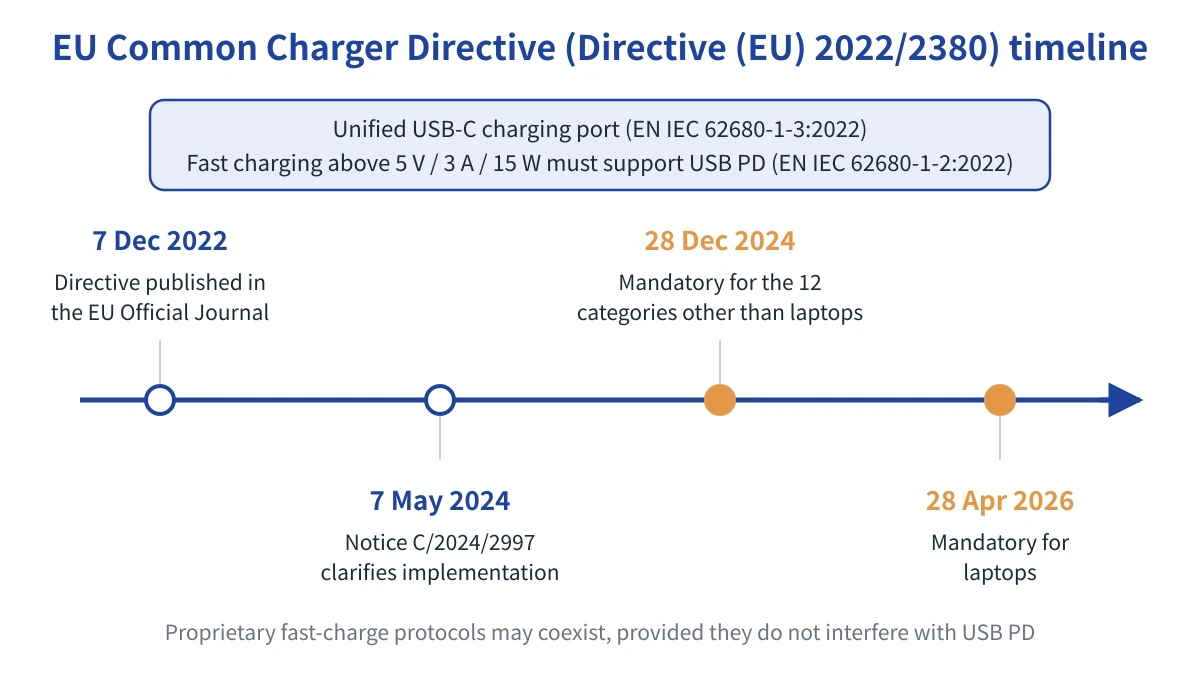
Key dates and technical requirements of the directive
Details clarified by notice C/2024/2997
On 7 May 2024, the Official Journal of the EU published notice C/2024/2997 as the official guidance document for the directive, answering implementation questions in a Q&A form. Several points bear directly on hardware design:
- Applicability: the directive applies to radio equipment that falls within the 13 listed categories, is fitted with a removable or embedded rechargeable battery, and can be charged by wire.
- Socket form: a 6-pin Type-C may not be used for charging — only the USB-C sockets specified by EN IEC 62680-1-3 (12, 16 and 24 pin) are allowed.
- Internal-power exception: radio equipment that contains an internal power supply and can be powered directly from AC mains is outside the scope of the directive.
- Other sockets: other types of charging socket are allowed, provided the device is also equipped with the specified USB-C socket.
- Proprietary protocols: charging protocols other than USB PD may still be used, provided they do not interfere with the normal operation of the USB PD protocol.
What it means for power and fast-charge design
The directive sets USB-C plus USB PD as the floor for fast-charging devices above 15 W, while leaving proprietary protocols room to coexist under the condition that they must not interfere with USB PD. That means a protocol chip has to implement the USB PD base negotiation reliably and also handle compatibility and switching with proprietary protocols. The 28 April 2026 date for laptops likewise puts higher-power USB-C PD solutions on the agenda. We distribute Huayuan's PD fast-charge and AC/DC lines; the on-site selection tool filters by power tier and protocol version, while coexistence schemes for proprietary protocols alongside USB PD are evaluated with the manufacturer through our engineers.
Source: Huayuan technical article "The EU Official Journal Has Published Notice C/2024/2997" · www.hysemi.com/TechnicalArticles/info_itemid_25.html; directive full text at EUR-Lex (Directive (EU) 2022/2380).