
On sample-and-hold LCD panels, fast-moving content tends to blur: persistence of vision "smears" adjacent frames together in the viewer's eye, producing motion blur. Black Frame Insertion (BFI) is a backlight-timing technique aimed at this problem — it inserts an all-black frame between two adjacent frames to "reset" the eye's persistence of vision and make motion look clearer.
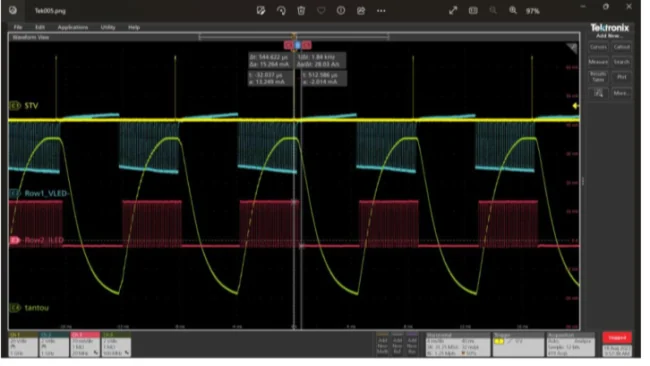
The four signals watched together during BFI verification. Image: HYASIC
Principle: break persistence of vision with an all-black frame
BFI inserts a brief all-black frame between each lit frame. As the screen refreshes quickly, that black frame makes it easier for the eye to distinguish each individual frame while tracking a moving object, reducing motion blur. It does not change the LCD's own response speed; instead, through the backlight's on-off timing, it steps around the most-blurred stretch of the image while the liquid crystal is still flipping.
The key is aligning the backlight with LCD response time
BFI is not simply "flashing the backlight" — it has to be coordinated with the LCD response time. The debugging approach Huayuan gives is: first turn off local dimming (LD) and drive the backlight PWM duty cycle to full, play a black-white switching pattern, and use a light sensor with an oscilloscope to measure the LCD response time T1; the backlight must be turned on only after T1, stepping around the blurred phase while the liquid crystal is flipping and emitting light only during the stable display phase. At the same time, the inserted black-frame PWM duration must be long enough that the backlight can go fully dark while the next frame's liquid crystal has not yet settled. Verification typically watches the timing relationship among four signals together: VSYNC (available from the TCON side), backlight voltage, LED current and the on-screen light-sensor signal.
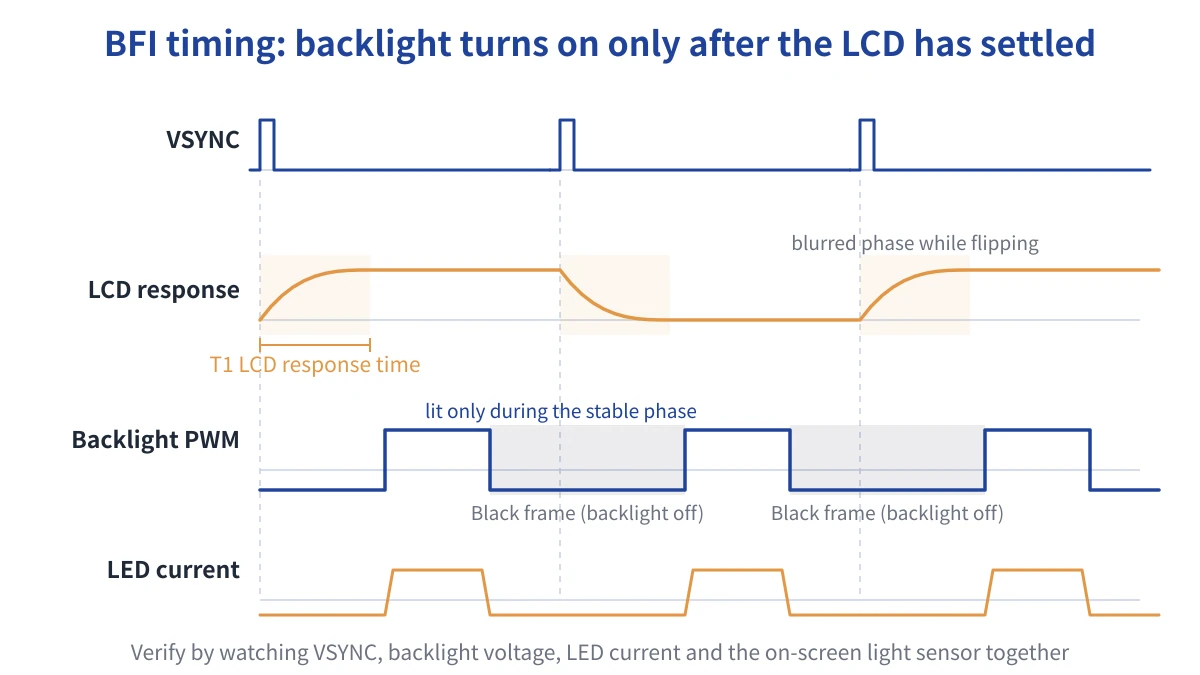
BFI timing: the backlight turns on after the LCD response time T1 and is fully off during the black frame
What it means for selection
The effectiveness of BFI depends on whether the backlight drive can precisely control the turn-on instant and the black-frame duration — which places demands on the PWM timing precision of the backlight Driver and its ability to synchronize with VSYNC, and it also has to be planned together with other backlight strategies such as local dimming (LD). We distribute Huayuan's MiniLED backlight Driver line; PWM timing precision and VSYNC synchronization for BFI can be filtered by parameter in the on-site selection tool, and parts not yet listed are confirmed with the manufacturer by our engineers.
Source: Huayuan technical article "BFI Function" · www.hysemi.com/TechnicalArticles/info_itemid_75.html