
The MOSFET remains the most fundamental switching device in power and conversion circuits, and the choice of process technology directly shapes system efficiency, cost and reliability. Shielded-Gate Trench (SGT) and Super Junction (SJ) are the two mainstream process routes running in parallel today — covering low-to-medium and medium-to-high voltage respectively — and understanding where each one fits matters more than comparing a single parameter in isolation.
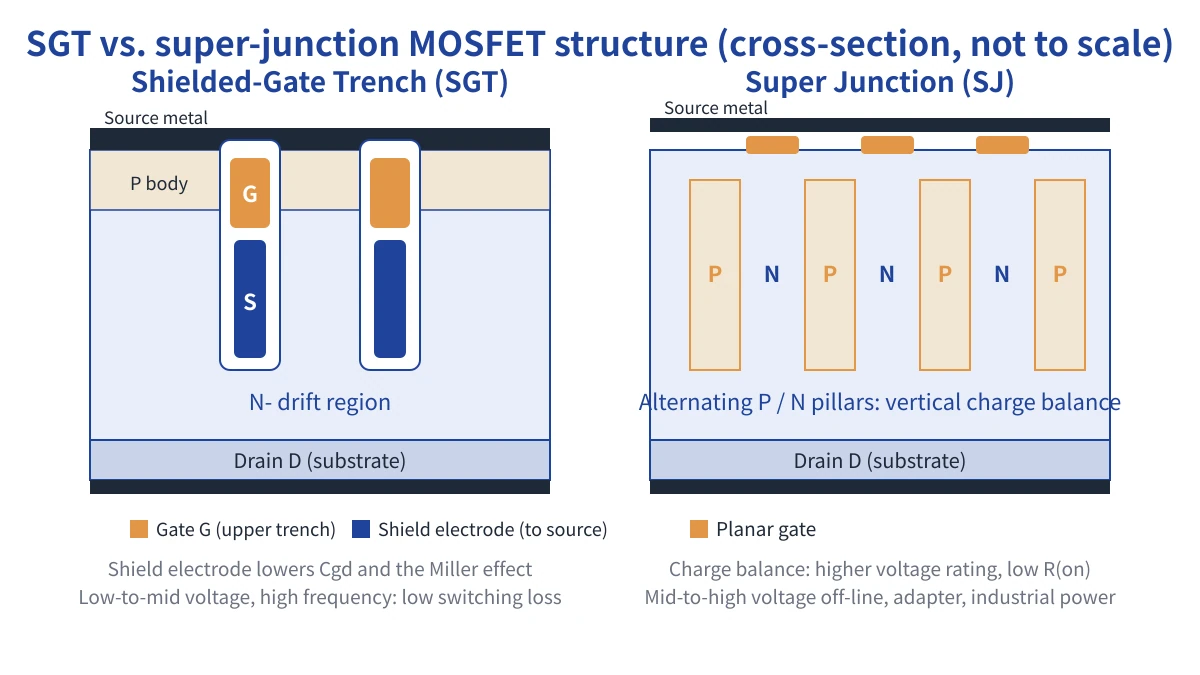
SGT and super-junction MOSFET structures (cross-section, not to scale)
SGT adds a shield electrode beside the trench gate to reduce gate-drain capacitance and the Miller effect, trading this for lower switching loss and faster switching speed. The process is mature and cost-effective, making it a common choice for low-voltage, high-frequency switching scenarios such as synchronous rectification, battery management, motor drive, and ignition or load switching. Super Junction, by contrast, relies on a vertical charge-balance structure to push withstand voltage higher while keeping on-resistance low, making it better suited to medium-to-high-voltage off-line power supplies, adapters and industrial power — the key route for controlling conduction loss once the voltage platform moves up.
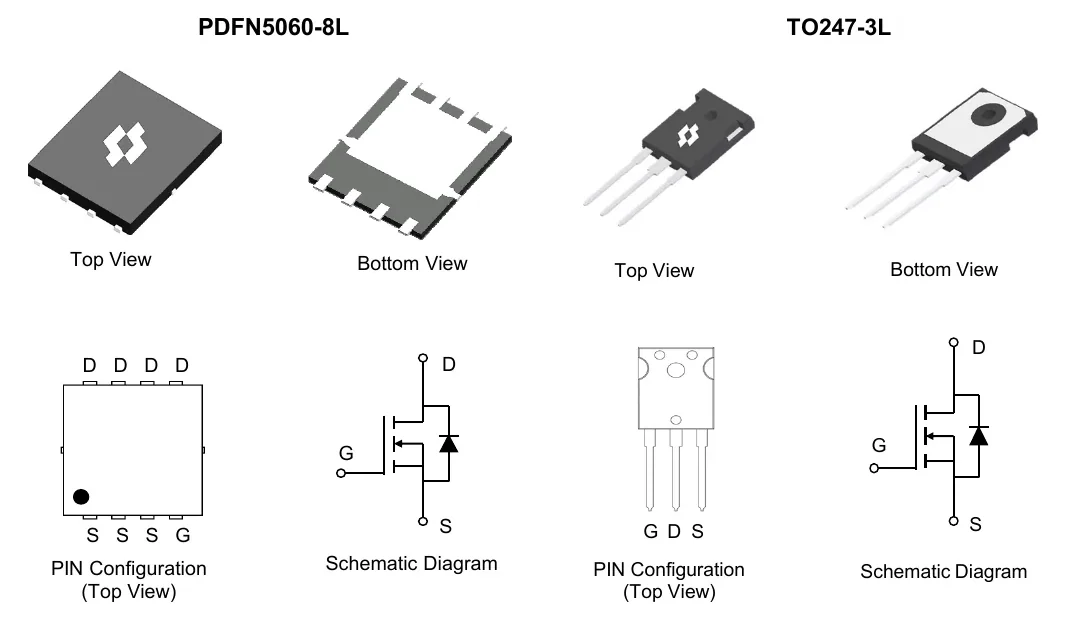
Typical packages on the two routes: PDFN5060-8L for an SGT MOSFET and TO-247-3L for a super-junction MOSFET
The two routes are complementary rather than substitutable: for low-voltage, high-frequency designs, prioritize switching loss and gate-drive matching; for medium-to-high-voltage designs, prioritize voltage margin and avalanche energy. Real-world selection also has to weigh body-diode reverse-recovery behavior, package parasitic inductance and thermal design margin — not just one or two headline figures on a datasheet. Across the product lines we distribute, both SGT and Super Junction routes are represented by volume-production parts spanning automotive to industrial power.
For engineering and sourcing teams, the more useful question isn't "which process is more advanced" but rather clarifying the application's voltage platform, switching frequency and thermal budget first, then matching the process route to that context. With the voltage platform and switching frequency fixed, filtering by voltage, current and package in the on-site selection tool is enough; the hard cases that cut across both routes are for our engineers.