
SineSemi has introduced SMT3001ALR, a 30V N-channel MOSFET in a thin, compact PDFN3333-8L package with a typical RDS(ON) of 0.99 mΩ at VGS = 10 V. Its target applications are synchronous rectification in switch-mode power supplies and BLDC motor drives. The same series includes SMT3001BLP, a PDFN5060-8L device with a typical RDS(ON) of 1.0 mΩ.
Key figures for the pair: SMT3001ALR is rated for 139 A continuous current, with a typical VGS(th) of 1.7 V, Ciss/Coss/Crss of 2,978/2,050/160 pF, a typical Qg of 48 nC and an FOM of 48. SMT3001BLP is rated for 209 A, with a typical VGS(th) of 1.6 V, capacitances of 2,854/1,839/118 pF, a typical Qg of 43 nC and an FOM of 43. (Figures as published at the time; see the product page for current values.)

Key-parameter table for SMT3001ALR and SMT3001BLP. Image: SineSemi
In a like-for-like comparison: in PDFN3333-8L, SMT3001ALR's 0.99 mΩ typical on-resistance is up to 43.4% below a competing part at 1.75 mΩ; in PDFN5060-8L, SMT3001BLP's RDS(ON) × Qg figure of merit (FOMg, 1.0 mΩ × 43 nC) is 28.3% below the compared device (1.3 mΩ × 46.1 nC). The lower on-resistance translates into reduced conduction loss, more output power and fewer paralleled devices; the better FOMg into lower switching loss and lower dissipation. SineSemi also provides reference schematics for a synchronous-rectifier stage and a BLDC motor-drive stage.
The application validation used a two-switch forward supply for a display panel: 220 V AC input, 100 kHz switching, 5 V / 60 A (300 W) DC output, with SMT3001BLP and a competing device fitted in turn as the secondary-side synchronous rectifier on the same platform. Without a heatsink and after 5 minutes of continuous running, SMT3001BLP delivered 5.06 V / 60.10 A (303.99 W) from 341.12 W of input — 89.11% efficiency — with a bare-board MOSFET temperature of 155.9 °C, against 88.53% and 161.5 °C for the competing part. With a heatsink fitted and 30 minutes of running, SMT3001BLP delivered 5.06 V / 60.78 A (303.9 W) from 340.66 W — 89.21% — against 88.21% for the competing part.
The conclusion drawn from the test: MOSFET synchronous rectification cuts power loss substantially compared with conventional diode rectification, and this supply reached close to 90% efficiency under ordinary cooling; under identical conditions the SMT3001BLP build ran at higher system efficiency and lower device temperature rise. The reason is that a secondary-side synchronous-rectifier MOSFET in a high-frequency supply benefits from low forward on-resistance RDS(ON), low body-diode reverse-recovery charge Qrr, low body-diode forward drop VSD and low output capacitance Coss, all of which pull down switching and conduction losses.
At the time of publication the 30V SMT3001 line spanned both PDFN5060-8L and PDFN3333-8L: SMT300SALP (PDFN5060-8L, 0.57 mΩ, 330 A), SMT3001ALP (PDFN5060-8L, 0.99 mΩ, 207 A), SMT3001ALR (PDFN3333-8L, 0.99 mΩ, 139 A), SMT3001BLP (PDFN5060-8L, 1.00 mΩ, 209 A), SMT3001BLR (PDFN3333-8L, 1.05 mΩ, 140 A), SMT3001CLP (PDFN5060-8L, 1.30 mΩ, 181 A), SMT3001CLR (PDFN3333-8L, 1.50 mΩ, 119 A) and SMT3001DLP (PDFN5060-8L, 1.40 mΩ, 180 A). Datasheets for SMT3001BLP, SMT300SALP and SMT3001ALR are published on SineSemi's website.
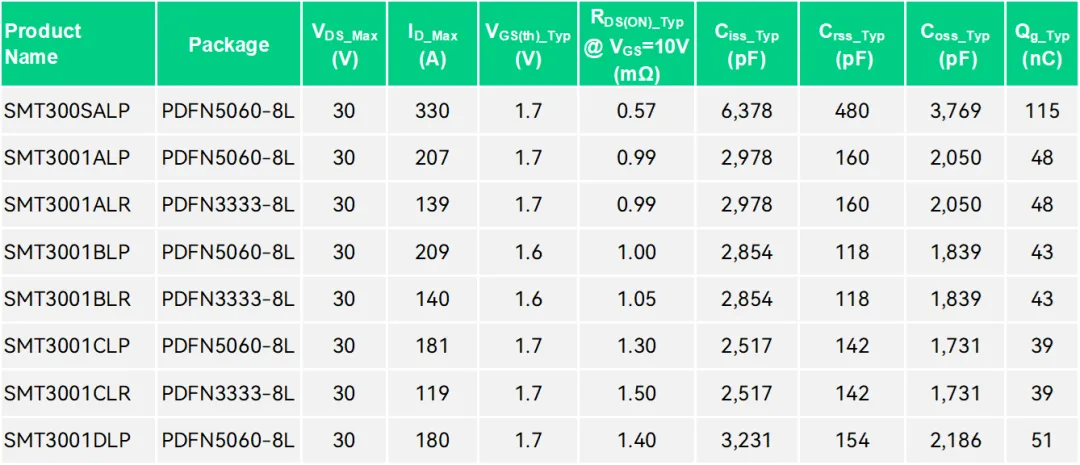
SMT3001-series 30V MOSFET line-up (October 2024). Image: SineSemi
SineSemi has also set the next milestone for its compact, high-power-density 30V PDFN3333-8L family: a typical RDS(ON) of 0.75 mΩ, a further 25% improvement on today's 0.99 mΩ.
Source: SineSemi Product News · www.sinesemi.com/cpxw/3738.html