
MiniLED backlighting takes dimming granularity from large-zone control down to dense local zones. The payoff in picture quality comes with a real jump in driver-chain complexity, typically split between a Driver IC handling current drive at the tail end of the chain and a backlight controller (BCon) handling zone-level data distribution and timing. Evaluating either chip's datasheet in isolation misses this system-level cost.
Display-power application key visual. Image: HYASIC
Driver IC: precision versus thermal trade-offs
Key specs are channel count, per-channel current headroom, and how dimming resolution is implemented. DC (analog current) dimming tends toward color shift at low current; PWM dimming leans on higher switching frequency to suppress flicker but raises EMI suppression difficulty; hybrid dimming moves control logic on-die for higher effective grayscale, at a higher cost. Channel count and current ceiling also set how many driver chips a given backlight board needs — fewer chips save PCB area, but concentrated current raises thermal pressure.
BCon: local-dimming density versus system bandwidth
BCon streams per-zone grayscale data to a chain of Driver ICs; the bottleneck is rarely compute — it's bandwidth. More zones and higher refresh rates mean the interface has to trade routing simplicity against bandwidth headroom — whether it carries a dedicated clock line, runs serial, or uses parallel lanes directly caps the achievable zone-and-refresh combination, and also affects PCB layer count and connector cost.
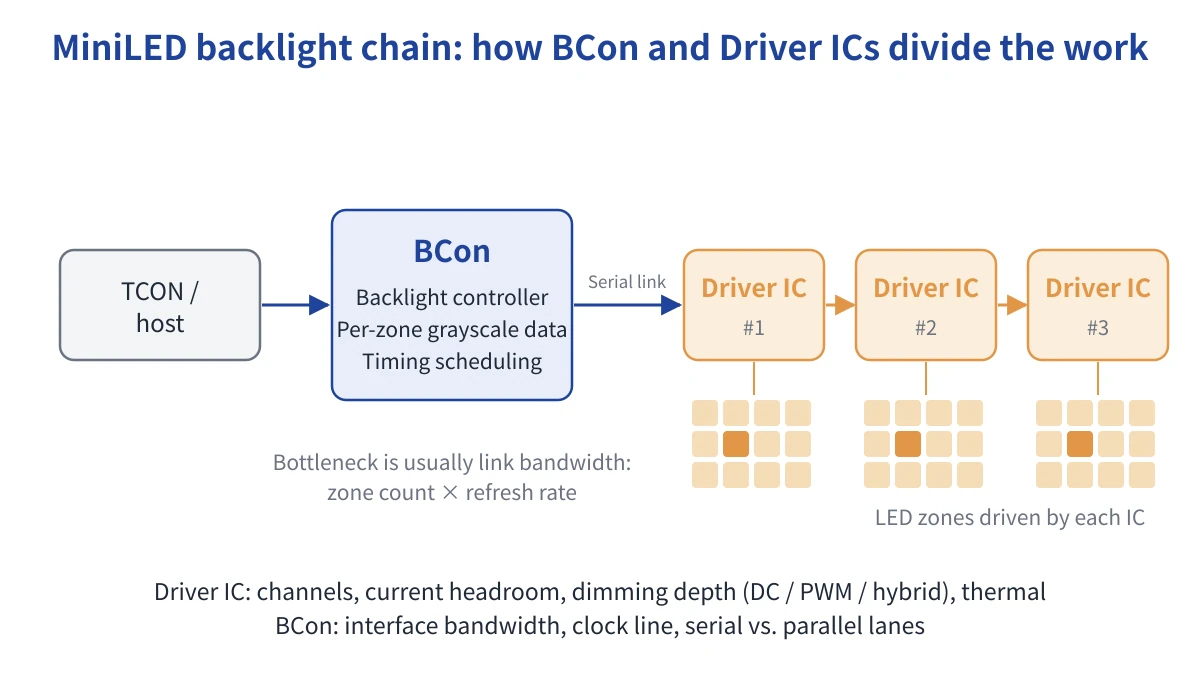
The MiniLED backlight chain: BCon distributes zone data and timing, Driver ICs handle current drive
Common pitfalls
Stacking up driver dimming resolution means little if the controller link can't keep up. Under variable refresh rate (VRR), if the driver and controller can't coordinate dimming timing across a refresh change, brightness can jump. Functional-safety features are often overlooked in consumer designs, driving up rework cost later.
How to choose
For high-end, high-refresh, high-zone-count designs, confirm the controller's interface bandwidth has headroom and matches the driver's dimming mode. For cost-sensitive designs, simplifying the interface topology usually pays off more than pushing driver bit depth higher. For automotive and long-service-life applications, put functional-safety features and junction-temperature margin at the top of the checklist. The product lines we distribute cover both MiniLED backlight Driver ICs and BCon controller chips; the interface match between Driver and BCon can be checked by parameter in the on-site selection tool, with the zone-count-to-bandwidth pairing confirmed by our engineers.